 Trim My Crib™
Pick your ceiling style: boards, stains and which way they run
A few choices shape the whole look of an outdoor wood ceiling. Here is the fun part of the planning.
Updated · sources listed at the end
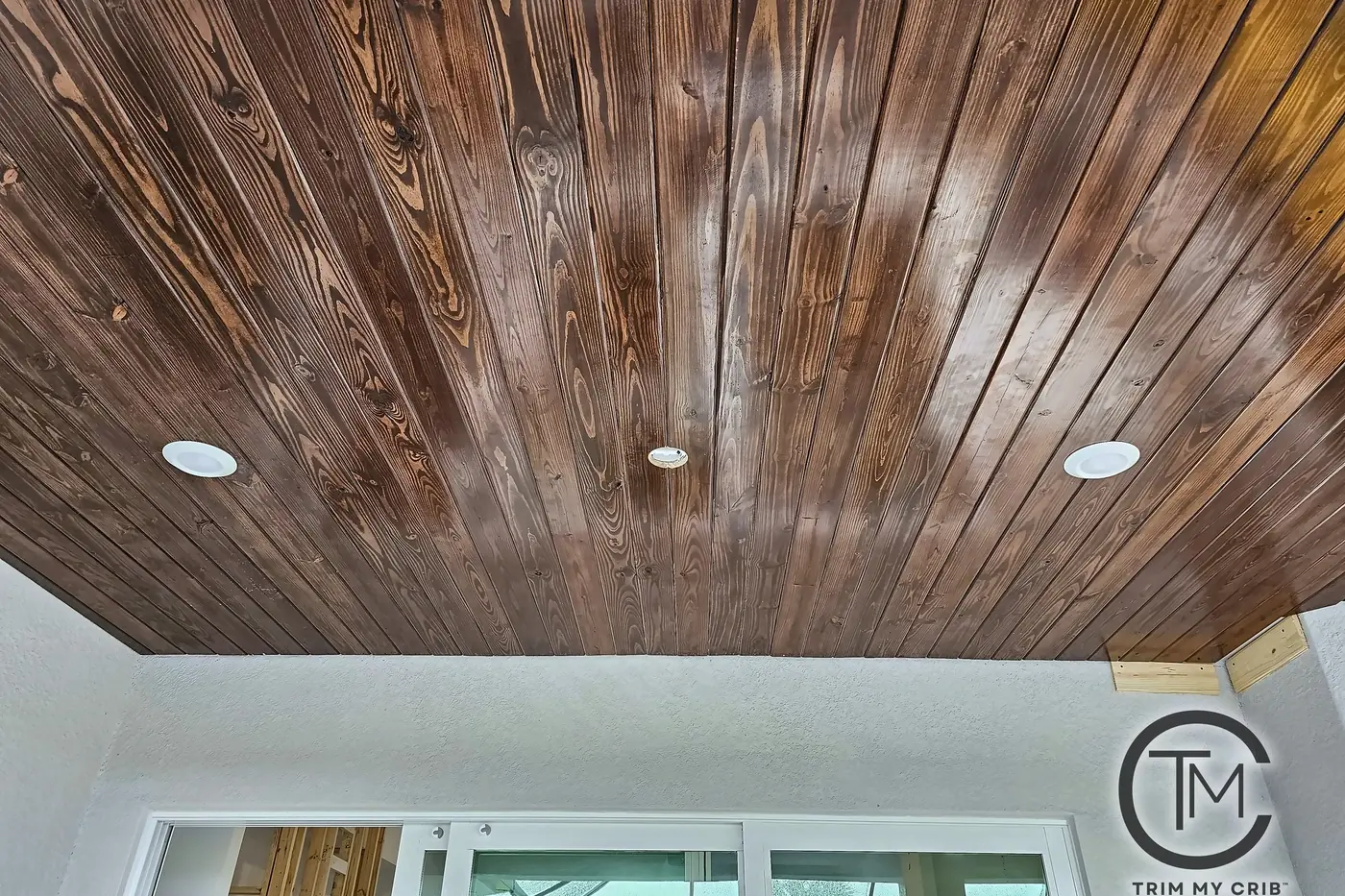
Narrow or wide boards?
Narrow tongue-and-groove boards make lots of fine lines and read as classic and tailored. Wider planks feel relaxed and a little rustic, with more of each board’s grain on display. On a big lanai, wide planks keep the ceiling from looking busy; on a small entry porch, narrow boards make the space feel detailed and finished.
Which way should the boards run?
Run the boards toward the view and they pull your eye out to the pool or the lake. Run them across the lanai and the space reads wider. A diagonal or herringbone inset makes a showpiece over a seating group or the outdoor kitchen. If the lanai has a beam or a step in the ceiling, that line is a natural place to change direction.
Stain or paint?
Stain lets the wood be wood: grain, knots and color shifts from board to board. Paint gives a smooth, calm surface and is a great fit for cottage, coastal and farmhouse homes. A painted pale blue ceiling is a porch tradition across the South, and a crisp white works with almost any house color.
Frames, steps and borders
A border board around the edge or a stepped frame where the ceiling meets the wall gives the boards a clean finish and hides the transition. A frame around the fan or a lantern turns the fixture into a focal point.
| If your lanai is… | Consider |
|---|---|
| Long and narrow | Boards running across the short side to widen it visually |
| Facing a lake or pool view | Boards running toward the view |
| Low ceilinged | A lighter stain or paint to keep it airy |
| Tall with a vaulted roof | A rich stain to bring the ceiling down to a cozy scale |
Rules of thumb we use for planning; every lanai is different.